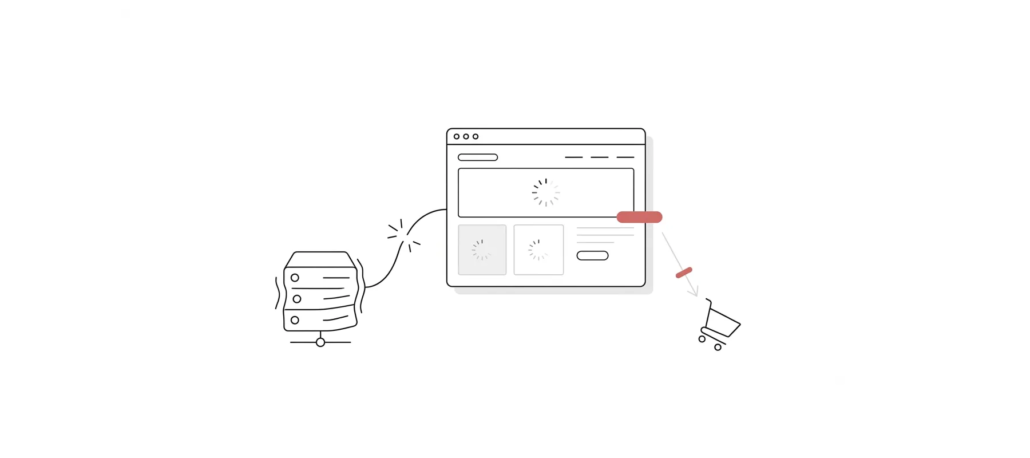
Why Cheap Hosting Can Cost You Sales
When businesses launch a new website, hosting is often treated as just another expense to keep as low as possible. After all, if one provider charges a few euros a month while another charges several times more, it can seem like an easy place to save money.
The problem is that hosting affects far more than where your website is stored. It influences how quickly pages load, how reliable your site is, how secure customer data remains, and whether visitors can actually complete a purchase.
For many businesses, the hidden costs of cheap hosting end up being much higher than the monthly savings.
Slow websites lose customers
Website speed has a direct impact on conversions.
Modern users expect pages to load almost instantly. If a page takes several seconds to appear, many visitors simply leave before they have a chance to explore your products or services. This is especially true for online stores, where customers can easily continue shopping elsewhere.
A slow website can affect your business in several ways:
- visitors abandon the site before viewing products;
- shopping carts are left unfinished;
- fewer enquiries and purchases are completed;
- overall customer satisfaction decreases.
Website speed also plays a role in SEO. While it’s only one of many ranking factors, search engines favour websites that deliver a good overall experience. If your pages consistently load slowly, they may become less competitive in search results, reducing the amount of organic traffic your website receives over time.
Many low-cost hosting plans rely on heavily shared servers.
This isn’t necessarily a problem by itself. Shared hosting is perfectly suitable for many websites when it’s properly managed. The issue arises when providers place too many customers on the same server in order to reduce costs—a practice often referred to as overselling.
When another website on the same server suddenly receives a large traffic spike, runs resource-intensive processes, or becomes the target of a cyberattack, every other website sharing those resources may slow down or become unavailable.
For an online business, even short periods of downtime can have real consequences:
- customers cannot place orders;
- contact forms stop working;
- payments may fail;
- visitors lose confidence in the business.
A few missed sales can easily cost far more than the annual difference between cheap and high-quality hosting.
Another consideration is scalability. As your business grows, your website should be able to handle increased traffic without slowing down. Whether you’re launching a seasonal promotion, running a successful advertising campaign, or seeing a spike in visitors after being featured in the media, your hosting should be able to keep up. A hosting provider that offers an easy upgrade path helps ensure your website can grow alongside your business.
Advertising becomes less effective
Many businesses invest in Google Ads, Meta advertising, email campaigns, or social media promotions to attract visitors.
But advertising only works if people actually reach a functioning website.
Imagine paying for hundreds of clicks during a promotion, only for visitors to land on pages that load extremely slowly or display an error because the server is temporarily unavailable. Your advertising platform still charges for those clicks, but the opportunity to convert those visitors into customers is lost.
Reliable hosting helps ensure your marketing budget isn’t wasted by technical issues outside your control.
Weak security can become an expensive problem
Security is another area where low-cost hosting providers sometimes cut corners.
Not every inexpensive host has poor security, but cheaper plans may offer fewer protective features, less frequent monitoring, limited malware protection, or less robust backup systems.
If your website is compromised, the consequences can include:
- customer data being exposed;
- malicious software appearing on your website;
- search engines warning visitors that your site may be unsafe;
- valuable business data being lost.
Recovering from a security incident often takes significantly more time and money than preventing one in the first place.
Regular backups are equally important. If something goes wrong during an update, a hardware failure occurs, or files become corrupted, a recent backup can restore your website quickly. Without one, recovery may be difficult—or impossible.
Poor support means longer downtime
Technical problems rarely happen at convenient times.
A website might stop working during a weekend sale, after an unexpected software update, or in the middle of a busy marketing campaign.
With some budget hosting providers, support is limited to basic ticket systems with long response times. Waiting many hours—or even days—for assistance can be extremely costly if your website generates revenue every day.
Quality hosting providers typically offer faster technical support, experienced engineers, and clear procedures for resolving urgent issues, helping businesses minimise downtime.
The cheapest option isn’t always the most affordable
Choosing hosting based only on price can become expensive in ways that aren’t immediately obvious.
A few euros saved each month may eventually be outweighed by:
- lost sales from slow loading pages;
- downtime during busy periods;
- wasted advertising spend;
- recovery after security incidents;
- time spent dealing with technical problems.
When viewed from that perspective, reliable hosting becomes an investment in your website’s performance rather than simply another operating expense.
How to choose hosting for a business website
Instead of focusing only on the monthly price, consider what you’re actually receiving.
Look for a provider that offers:
- reliable uptime with a clear Service Level Agreement (SLA);
- sufficient server resources for your website’s traffic;
- regular automated backups;
- strong security measures;
- responsive technical support;
- room to scale as your business grows.
For businesses that prefer to leave the technical side of hosting to a specialist, managed WordPress hosting can provide the performance, security, backups, and support needed without having to manage the server yourself.
If your website is critical to generating leads or online sales, these factors are usually far more important than finding the lowest possible monthly fee.
Looking for managed WordPress hosting?
If you’re running a WordPress website or WooCommerce store, choosing a hosting provider that understands the platform can make day-to-day management much easier.
At Coma Cloud, we offer managed WordPress hosting built on EU-based infrastructure and optimized specifically for WordPress. Every plan includes automated daily backups, free SSL, security monitoring, staging environments, and support from our own WordPress team—the same people who build, optimize, and maintain WordPress websites every day. The platform is also designed with performance in mind, using optimized PHP configurations, caching, and proactive monitoring to help keep your website fast and reliable.
Because we develop WordPress websites ourselves, we understand the issues businesses commonly face—from plugin conflicts and WooCommerce performance to security and updates. That means you get hosting backed by practical WordPress experience, not just general server administration.
Conclusion
Hosting is one of the foundations of a successful website. While cheap plans can be suitable for personal projects or small test sites, business websites depend on speed, reliability, security, and fast support.
The monthly savings of a low-cost hosting plan may look attractive at first, but the real cost often appears later—in lost customers, interrupted sales, wasted marketing spend, and time spent fixing avoidable problems. Investing in reliable hosting helps protect your website, your reputation, and ultimately your business.
Our specialization is WordPress website development and maintenance. Contact us for a free consultation — [email protected], +371 29394520
